
Welcome to a CD life style. We will try to help you with your new adventure. Those of you who were recently told you have Celiac Disease (CD) and you were given instructions about your future diet plan, you will discover nutrition plays a key roll in your daily schedule. Your life style will now start changing far greater than just the diet. Following the diet plan, reading labels, and staying informed are some of the most important things to remember. You will also find you are more prone to complications like fractures, anemia, change in eye sight, weakness and fatigue because even though we maintain a adequate diet we can become malnourished. There can be a loss of nutrients, like calcium, because your body can not absorb the nutrients through the small bowl and this leads to other serious problems.
The Daily News & Analysis (DNA) references the fracture issue in an articles on 2/6/2011. (as follows) Celiac disease patients prone to fractures: Published: Sunday, Feb 6, 2011, 1:16 IST By Menaka Rao | Place: Mumbai | Agency: DNA | |
| |
Are you new to the world of Celiac Disease?


Another great find from Celiac.com --YUM!
Blackened Cajun Catfish (Gluten-Free)
- By Jefferson Adams
- Published Today
- Gluten-Free American, British/UK Recipes
- Unrated
 JEFFERSON ADAMS

Jefferson Adams is a freelance writer living in San Francisco. His poems, essays and photographs have appeared in Antioch Review, Blue Mesa Review, CALIBAN, Hayden's Ferry Review, Huffington Post, the Mississippi Review, and Slate among others.
View all articles by Jefferson Adams
The finished blackened cajun catfish. Photo: CC-The DLCBlackening is a really fun way to cook fish. Nothing seems to beat the bold flavor that comes from a perfectly seared crust. Blackening fish on a cast-iron skillet creates intense heat and smoke so always work in a well-ventilated kitchen.
The rub in this recipe is one of many variations on a classic Cajun rub and is also perfect for chicken, beef steaks, or even vegetables. You can mix it up by serving different fish; snapper and swordfish would also hold up really well. Serving fish with lemon not only cuts the intense flavor of the spices, but also gives the fish a refreshing bite.
Ingredients:
4 firm catfish fillets, 6-8 ounces each
½ cup olive oil, plus extra for drizzling
1 large lemon, cut into 4 wedges
1 teaspoon dried thyme
1 teaspoon marjoram
1 teaspoon coriander
1 teaspoon garlic powder
1 tablespoon paprika
1 tablespoon ground red pepper
2 teaspoons cracked peppercorns
1 teaspoon coarse salt
Directions:
Combine all spices to create a rub and spread in a shallow pan. Set aside.
Heat a large cast-iron skillet until very hot, about 5-10 minutes. Meanwhile, rinse and pat dry fish. Generously coat both sides of each steak with oil and lay in the spice mixture. Turn to thoroughly cover both sides.
Place two steaks in the heated skillet over medium-high and drizzle lightly with oil. Cook for 3-4 minutes and turn. Drizzle with a little more oil and cook for an additional 2-3 minutes, depending on thickness of fish. Remove cooked fish.
Add additional oil if necessary and repeat with remaining steaks.
Serve with fresh lemon juice, one wedge per steak.
Following our genetic trail -- what may they find??
Private MD News
Home | News | Autoimmune DiseasesResearchers find common genetic risk factors for Crohn's and celiac disease
Updated: 2011-01-31 12:46:48 CST Category: Autoimmune Diseases
 Individuals who have received a positive celiac disease test are significantly more likely to also develop Crohn's disease at some point in their lifetime. A new study has shown that this may be due to the fact that the two diseases share some of the same genetic causes. The information could lead to improved treatments for both conditions.
Researchers from the University of Groningen in the Netherlands said that genetic alterations in two areas of DNA appear to increase the risk of developing one or both of the diseases.
The fact that celiac and Crohn's disease share some of the same risk factors make sense, the researchers said. They are both inflammatory bowel diseases caused by irregular immune system reactions in the digestive tract. In this regard, they can be very similar.
However, where celiac disease is sparked by a reaction to wheat, barley and rye products, Croh's disease is thought to be caused by a reaction to certain bacteria in the gut.
The researchers said that understanding these genetic factors that play into the development of the conditions could help them design improved treatments for one or both of the conditions.
Science working for you!
Check out this web site & story I'm passing along to you. Great news for Celiac Disease.
 Celiac.com 01/13/2011 - It might be rocket science, after all. Well, sort of. It turns out that engineering a good loaf of gluten-free bread is the focus of some of the best scientific minds in the food business.
It also turns out that scientists with the U.S. Department of Agriculture (USDA) in Manhattan, Kansas, have developed a process that produces a high-quality, gluten-free bread.
Such bread, if produced on a large scale, might benefit the millions of Americans with celiac disease who are unable to digest gluten, a protein found in wheat, barley and rye. Gluten-free grains include corn, sorghum, and rice, among others.
The new bread-making process is the work of chemists Scott Bean and Tilman Schober at the Agricultural Research Service (ARS) grain Quality and Structure Research Unit.
They discovered that removing a certain amount of fat from a corn protein called zein, allowed them to craft a gluten-free dough that is more like wheat dough, and free-standing, bakery-type rolls are more like traditional wheat rolls. ARS is the chief intramural scientific research agency of USDA.
Bean and Schober had some success crafting gluten-free pan bread using other grains, but they were unable to make free-standing rolls because the rolls expanded too much. According to Bean, the resulting bread was lower quality than comparable wheat bread.
Bean and Schober had shown earlier that zein-a readily available byproduct from corn wet milling and fuel-ethanol production-could be used to make dough that was more similar to wheat dough. The dough still didn't meet their standards, though, because the rolls produced from it were crumbly and flat.
Removing more of the fat from the zein protein's surface, Bean and Schober found, allowed the proteins to stick to each other much like wheat proteins do, giving the zein-based dough elastic properties similar to wheat dough.
Bean and Schober's findings may also apply to sorghum, which, says Bean, may prove to be a better grain to use since it is a gluten-free grain.
The team used corn as an intermediate step toward to achieve the ideal standard for gluten-free breads: a wheat-flour-like dough made with non-wheat proteins, resulting in products with a fluffy, light texture.
This research may prove useful in creating commercial, gluten-free bread for the 2 to 3 million Americans who have celiac disease. For many of those folks, tasty, gluten-free breads and rolls from corn, rice and sorghum would be a welcome addition to their diet.
Source:
Hello!
Good morning everyone.
I've been battling a few health issues so I'm not updating this blog as often as I would like, so please forgive the delay and please continue coming back to visit.
We do have great future plans for the blog and we should be evolving into something you will enjoy.
Have a great day.
Judy
I've been battling a few health issues so I'm not updating this blog as often as I would like, so please forgive the delay and please continue coming back to visit.
We do have great future plans for the blog and we should be evolving into something you will enjoy.
Have a great day.
Judy
Fast food is getting better all the time.
Hello sandwich lovers.
I don't know about you, but for me when I walk by a subway my mouth waters from the smell of baking bread. Eating a submarine sandwich and being gluten-free just don't mix. Many new breads gluten free on the market are somewhat good for making sandwiches but for me, I just haven't found the kind of bread it takes to make a really good sandwich. As you can tell, sandwiches are one of my favorite foods, so if subway has found a way to make a good bread, to make a really good sandwich, life would be very sweet.
If you miss a mouth watering sandwich like I do, take a look at this article from CNN.
I'm sure you will be thrilled.
OH by the way, they have not forgotten you dessert lovers. Their developing a very chocolate brownie.
The picture below is complements of this article:
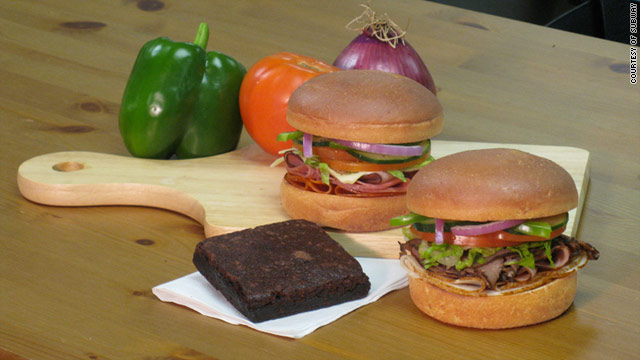
Please let me know what you think.
I don't know about you, but for me when I walk by a subway my mouth waters from the smell of baking bread. Eating a submarine sandwich and being gluten-free just don't mix. Many new breads gluten free on the market are somewhat good for making sandwiches but for me, I just haven't found the kind of bread it takes to make a really good sandwich. As you can tell, sandwiches are one of my favorite foods, so if subway has found a way to make a good bread, to make a really good sandwich, life would be very sweet.
If you miss a mouth watering sandwich like I do, take a look at this article from CNN.
I'm sure you will be thrilled.
OH by the way, they have not forgotten you dessert lovers. Their developing a very chocolate brownie.
The picture below is complements of this article:
Please let me know what you think.
Gluten free -- Allergy free -- Symptom free!
Learning and sharing information may be the key to opening doors to a fresh and unexpected balance in your life.
 We eat first with our eyes then with our taste. Following a diet is probably one of the most difficult things all of us, at one time or another, have tried to do. Whether your restrictions are gluten free due to Celiac Disease, allergies or something like a gull badder attack, when you see a luscious platter of food it's hard to say NO. Saying NO may mean the difference between living and dying! How do we know when food could be life threatening?
Symptoms such as gas, bloating, joint pain, swelling & weight gain, headaches, brain fog and fatigue may be due to many different types of diseases, aliments or allergies. I find new information every day about gluten free foods and that you don't have to have CD to benefit from a gluten free life style.
The following link is food for thought. Sharing information.
Celiac Disease Awareness Campaign from the National Institutes of Health
Living with Celiac Disease and finding the right balance of diet and life style requires up-to-date personal & professional information. Being aware of the newest tests, treatment and products are imperative to our daily health and happiness.
The following web site is a good reference:
Celiac Disease Awareness Campaign from the National Institutes of Health
The following web site is a good reference:
Celiac Disease Awareness Campaign from the National Institutes of Health

Gluten Free / Worry Free
Gluten free baking is now a delicious wholesome experience.
For me, Bob's Red Mill All-Purpose flour is just the right blend of expedients and taste. I've always bought any baked goods I needed until I discovered this all purpose flour. They also have great receipts available for anyone like me who never bakes.
Subscribe to:
Posts (Atom)

